I’ll be co-teaching a new workshop called Moving into Agreement: the Wheel of Consent and Contact Improvisation with Kathleen Rea in Toronto, May 7-10, 2026. To register, go here.
Kathleen interviewed me to talk about it. Here’s the interview, with captions and transcript:
Kathleen:
Can you tell us a little bit about yourself?
Sasha:
My name is Sasha Lasdon. I live in Madison, Wisconsin…. Also called Teejop on Ho-Chunk land. I put this combination for Wheel of Consent and contact and proposition workshop together partially because of the two threads of my work. One is working with the Wheel of Consent, both as a certified facilitator and as faculty with the School of Consent…. Which means that I help teach Like a Pro, which is, professional track for people working with individuals… And I’ve been doing that for a few years. I also am a contact dancer. I’ve been dancing contact Improvisation for 25 years. My home community is the Glacier community in the Great Lakes region. And I’ve been teaching and helping organize in my community for a 15 years.
Kathleen:
Can you tell us about the origins and evolution of the Wheel of Consent?
Sasha:
The Wheel of Consent is, a set of practices and theories created by Doctor Betty Martin. It came out of her exploration with Harry Faddis around XXXX and play and touch, and it opened her up to the questions of who’s doing an action and who is it for? And it came through a practice called the Three Minute Game, and she began working with it and realizing as she saw clients that they were missing pieces around touch. And so she began investigating this. It is also an inquiry form… that it came out of this inquiry of what practices, help people notice themselves better. I first took Like a Pro with Betty Martin in 2015, and so that was my official entry point.
I was introduced to it a little bit earlier through practices with the School of Body Electric, through erotic embodiment communities, and through the links with contact Improvisation through the Touch and Play festival in Spain in 2012. There were practitioners there who were threading in materials and naming it with that lineage. And I heard that I was like, oh… .okay
And then I also trained as a sexological body worker, in 2014. And that was another connection.
Kathleen:
The wheel diagram is so iconic with the Wheel of Consent. I always have this wondering about the moment when Betty Martin had the epiphany to represent her work in this circle diagram. So it is interesting to hear the process through which she developed the work..
So how has the wheel of consent affected your life?
Sasha: There’s so many threads that are possible there. I think a main piece that I find in my regular life is finding discernment and clarity. When interactions and dynamics are messy or muddy or confusing, that gives me some tools to step back, to notice myself, to give me some understanding, to discern who and what am I doing this for? What are the dynamics that are happening in a given situation? Can I take them apart? How do I make choices and allow myself to be in the equation of that? Not to erase other people from the equation, but to allow myself to be present in it.
Kathleen:
I have done several Wheel of Consent workshops and for me it helped me realize where I have gaps. Like I tend not to do this quadrant of the wheel very often. That I tend to find it more challenging. And so in the workshops, I was able to challenge myself to practice the pieces that I was less practiced at and maybe more uncomfortable with. And that was really, really useful because I don’t know if I would ever have figured that out without the simplicity and the clarity of that wheel and the quadrants.
Sasha:
Yeah, in this way it functions like a contact Improvisation score. It can be a base of practices that allow for playing with something. I found that too. It highlighted where I wasn’t very good at some particular things and had some very strong habits in other locations.
Kathleen:
Yeah, yeah. Like okay, I found a pattern I do and now I can ask myself Is it useful in my life or not useful in my life? That’s always a good question.
How have the Wheel of Consent practices change or shift your contact improvisation practice?
Sasha:
It opens up my questions, when I teach, contact improvisation around what’s happening in the space or the room? It shifts my compositional awareness a little bit. And it also deepened my quality of play and my practice of contact improvisation. Partially because I love asking questions. And both the wheel and CI forms do that. What’s actually happening here? They both to me are practices that build skills around noticing what’s actually going on. And what my perceptions are both expanding my capacity for perception but also questioning it. Really questioning it and letting my patterns drop away when I discover they are not useful. Like, making up a story about this other person I actually don’t know. If I want to know I might be able to ask and I might get an answer or I might not. Yeah. And so living in that unknown space is something that both the wheels and CI gave me greater practice for.
Kathleen:
There’s a bit of a thing that gets talked about in contact improv communities… A sort of disagreement about freedom and play. Generally people want this freedom to play. Right?. I have a master’s degree in expressive arts therapy and what they taught us is freedom to play only arrives when there’s a defined frame. And they use the example of like, of how play only comes when you have defined space and activities that create a frame. And they’re like, you have to have the board game structure or you have to have the proscenium arch of the theatre or the frame of the dance floor in order to play. So I’m struck by how the Wheel of Consent, I think, for me, has provided a bit of a framework, and then that helps play blossom.
Sasha:
Yeah, I like to have structure. In a way is a lens… a way to see things or to help hold the experience. So I appreciate the Wheel of Consent for that in my contact Improvisation. It really offers a great practice, scenario for asking some very specific questions that help us navigate and understand dynamics that are happening, and to play with them. Play is not necessarily described by the wheel, but it helps me get to the place where play is possible.
Kathleen:
And for me and other aspects of my life, not just contact improv have been affected by the Wheel of Consent work. Yeah. My husband and I have a laminated card on the Wheel right on our bookshelf next to our bed. That’s very useful.
Sasha:
Yeah. I often use some of the games of the wheel to, in those ways, warm up. Similar to how I might warm up for a dance! I’m moving through particular places in my body to warm myself up, to tune the instrument, to get ready to “dance”. And there are practices like that for contact improv … some of the tuning scores. And I’ve used the wheel in a similar way by playing the Three Minute Game (a Wheel of Consent practice) and then it can lead to whatever else we want.
Kathleen:
Yeah. Can you talk about the upcoming workshop that you and I are going to be facilitating. Sasha’s doing the Wheel of Consent stuff, and then together we’re going to lead the contact improv part.
Sasha:
I’m so excited to get to come and teach with you. We danced together before and have been in each other’s classes before. And that feels very anchoring to me and exciting. And I’m looking forward to it.
Kathleen:
Yeah I’m excited about it too.
Sash:
I’m hoping that people have an opportunity to dive into the wheel, whether they have never heard of it before or they have experience and want more practice time and space to be able to to notice where they might influence each other. And to notice where they don’t. I think that there’s some useful overlaps. And when it comes to putting two systems together, it’s really useful, I think, to find out where they don’t, because there’s all of this other possibility that’s still present in both. But I think that there’s positive influence back and forth.
Kathleen:
Yeah. It’s like there’s the wheel, there’s contact, and the dance between the two is where they overlap. And it’s the same in a dance with two CI dancers. There is you and there is me and the dance is where we lap. Yeah, so the two will dance together?
Sasha:
Yeah. What do you imagine? What do you hope that people might get from our teaching?
Kathleen:
I see. Contact improvisation communities struggle with many aspects of consent. I know consent will always be a messy process. But I think the Wheel of Consent can bring people more clarity. Doing the exercises will help perhaps bring more ease to consent practices especially in how they can help people fill in the gaps of where they are not, maybe asking for what they want. Also helping people notice their patterns. I think that’s just really useful. And I also think just the intention to spend some dedicated time working on consent and contact improvisation is just golden. For someone to give themselves that time, I think is really special. Yeah.even if it is 1 or 2 people in a community who will learn some new skills around this and they go back to their community of 50 people… That influences the whole community. It creates a shift.
But also I guess my big plan, you know, like my big plan for the world is like… world domination. through contact Improvisation and consent. And this workshop is a small piece on that road. I’m joking or course…. Sort of….
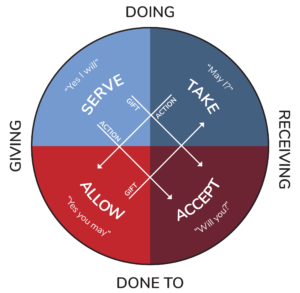
Diagram of the Wheel of Consent
 .
.